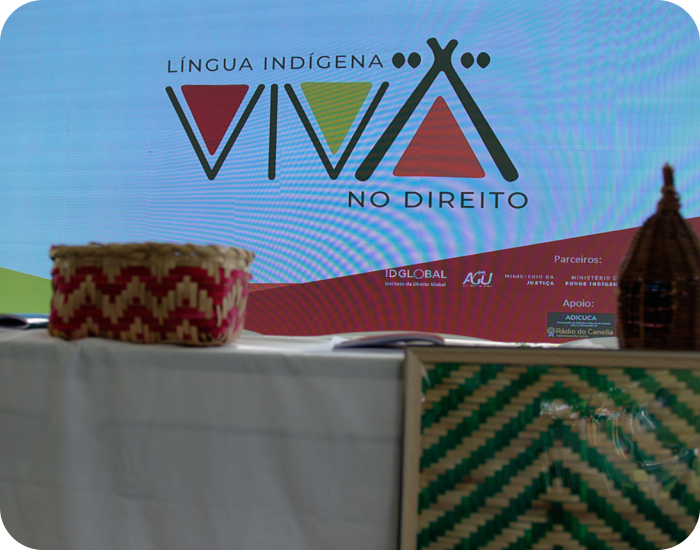
About the program
The Indigenous Language Alive in Law Program (LIVD) is an initiative aimed at promoting the recognition and appreciation of Indigenous languages within the Brazilian legal sphere. Conceived by the Office of the Attorney General (AGU), with support from the Ministry of Indigenous Peoples (MPI) and the Ministry of Justice and Public Security (MJSP), the program is implemented by the Institute of Global Law (IDGlobal).
The program’s goal is to translate the 1988 Federal Constitution, the International Labour Organization (ILO) Convention No. 169, and the Sustainable Development Goals (SDGs) into the Kaiowá, Kaingang, and Tikuna languages—the most widely spoken Indigenous languages in Brazil, according to the 2010 IBGE Census.
In addition to translation, the program conducts training workshops within the participating Indigenous communities, fostering Indigenous leadership at every stage: from free, prior, and informed consultation to the validation of translations and the definition of the methodological structure of the training sessions. This approach ensures that the process is participatory, culturally appropriate, and carried out in direct dialogue with the communities.
LIVD recognizes the essential role of ancestral languages in building a more plural, inclusive, and democratic justice system, strengthening access to fundamental rights and the leadership of Indigenous peoples within the legal field.
Methodology
The LIVD is developed using a collaborative methodology that integrates traditional knowledge and legal expertise.
The program is carried out in partnership with Civil Society Organizations (CSOs) that work directly with the participating Indigenous communities. These organizations rely on traditional translators from within the communities themselves, ensuring linguistic and cultural fidelity in the translations
In addition, the program hired Indigenous legal researchers from the involved ethnic groups—speakers of their respective languages—to serve as mediators between translators and partner institutions.
These researchers also prepared bilingual glossaries (Portuguese–Indigenous language) aimed at explaining complex legal terms, thereby facilitating understanding and the translation process.
At the end of the program, legal training sessions will be held by the Indigenous researchers themselves, in their original languages, within the participating territories, providing a formative return to the communities.